Author: Angeline Morgado, ASH Policy Intern
October 7, 2025
Click aquí para leer la versión en Español>
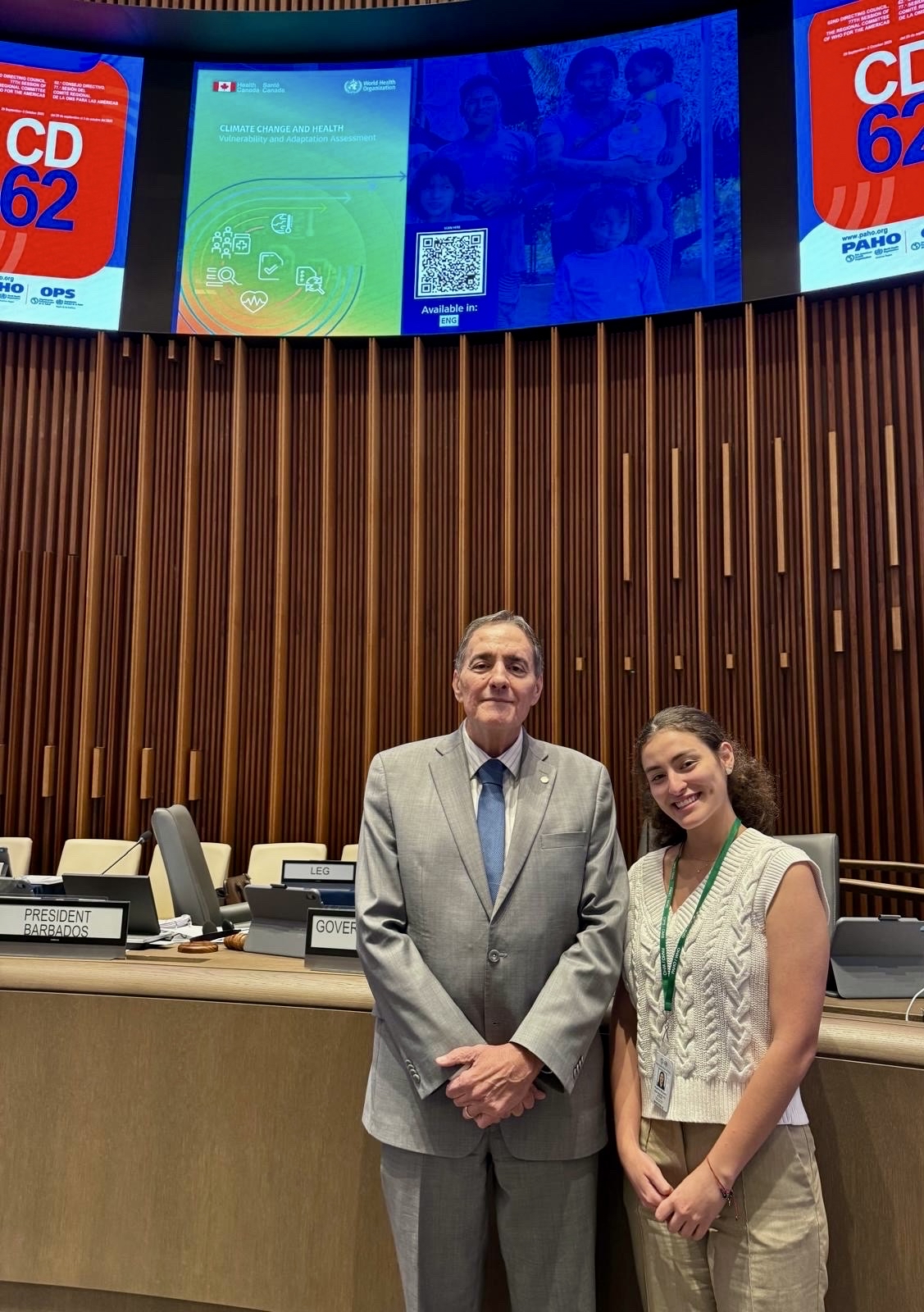
Before the opening session of the 62nd Directing Council, the 77th session of the WHO Regional Committee for the Americas, in Washington, D.C., USA, there was already a sense of community and prioritization of health with the Walk for Health event. PAHO Director Dr. Jarbas Barbosa led the movement both literally and metaphorically, promoting equal access to opportunities for exercise, healthy food, and free, accessible water.
The first day of the session was a very enriching experience, with presentations and educational booths that promoted the organization’s initiatives and efforts to address noncommunicable diseases (NCDs) and their risk factors, such as tobacco use.
There were informational booths about new strategies being implemented and the progress achieved, such as PAHO Forward, which aims to strengthen the organization by increasing transparency and reinforcing internal processes.
One initiative particularly relevant for tobacco control was the Better Care for NCDs Project, which enables surveillance and monitoring of NCD mortality and risk factor prevalence across the Americas. On their publications and resources portal, they have a section dedicated to tobacco cessation.
Educational opportunities were also highlighted, with information on the Virtual Campus for Public Health, which offers a wide range of free courses with certifications available to anyone interested. For example, one of them is “Training for Primary Care Providers: Brief Tobacco Interventions”.
What are NCDs, and why is tobacco control involved?
According to the Pan American Health Organization: “The term NCDs refers to a group of conditions that are not mainly caused by an acute infection, result in long-term health consequences and often create a need for long-term treatment.”
Tobacco control is fundamental when addressing noncommunicable diseases (NCDs), as tobacco use is one of the main risk factors that increases the likelihood of dying from an NCD (PAHO). It is linked to cardiovascular diseases, cancer, and chronic respiratory diseases, which together represent the greatest burden of morbidity and mortality in the Americas and worldwide.
Reducing tobacco use not only decreases the incidence of these diseases but also eases the burden on health systems and improves people’s quality of life. According to PAHO, including exposure to secondhand smoke, tobacco is responsible for more than 7.2 million deaths each year, and this figure is expected to rise even further in the coming years. Thus, tobacco cessation initiatives are a central part of the NCD prevention and control strategies promoted by PAHO/WHO.
People’s right to health serves as one of the human rights frameworks that ASH promotes through its work on tobacco control.

On the second day, Beatriz Champagne, dedicated to the prevention and control of NCDs in the Americas with the Healthy Americas’ Coalition (CLAS), asked a question in the panel on Innovative Approaches and the Regional Revolving Fund.
“Has cytisine been added as an essential medicine in The PAHO Regional Revolving Funds (RRF)? This is as a medicine that helps people quit smoking, given that it is a low-cost and very effective treatment. Considering that we have millions of smokers in our region, the possibility that many could quit would be very positive, since we know that more than 70% of those who smoke want to quit, but are not always able to. Cytisine is the name, and WHO has now included it as an essential medicine.”
Santiago Cornejo, Executive Manager of Regional Revolving Funds replied: “All medicines included in the WHO list are eligible, but their adaptation depends on their quality, waiting times, and costs for member countries.”
Beatriz commented later to ASH: “In this sense, it will be a challenge to ensure that each country is willing to request the medicine. More support is needed, or even a coordination mechanism, to help manage the inclusion of cytisine in the funds.”
Many of the advocates working in tobacco control know someone in our families who smokes, and when they visit a health professional, the response is often simply “quit smoking.” However, without significant support or access to medicines, which are often unavailable or too expensive, quitting becomes much more difficult. This is why it is important to continue bringing the issue of tobacco to the table, to support adults who currently lack access to these tools and are not at fault for being victims of the industry.
This led to the beginning of substantial conversations on the risk factors for noncommunicable diseases (NCDs) and the progress that countries have made on this issue. It was one of the most highly engaging topics, with more than 20 Member States sharing their processes and comments on the action plan for the prevention and control of NCDs.
On the third day, countries unanimously adopted the Action Plan for the Prevention and Control of Noncommunicable Diseases 2025–2030; the room filled with applause, inspiring all stakeholders involved in the discussion.
On behalf of Action on Smoking and Health (ASH), the Healthy Americas Coalition (CLAS), Corporate Accountability, the Global Alliance for Tobacco Control, and Vital Strategies, we intervened to welcome the report and highlight progress in strengthening NCD policies.
We emphasized the importance of protecting public health policies from corporate interests by implementing the provisions of Article 5.3 of the WHO Framework Convention on Tobacco Control (FCTC).
We also celebrated WHO’s decision to include cytisine in the List of Essential Medicines, providing a safe, affordable, and effective smoking cessation therapy.
Finally, we called on countries to hold industries accountable and to move forward with policies grounded in human rights and gender equality.
What is FCTC Article 5.3, and why is it important in the context of noncommunicable diseases?
 Article 5.3 of the WHO Framework Convention on Tobacco Control (FCTC) establishes that public health policies on tobacco control must be protected from the interests of the tobacco industry. This is fundamental because corporate interference has historically delayed or weakened effective tobacco control measures. By calling on countries to hold industries accountable and to advance policies based on human rights and gender equality, the principle is reinforced that health protection must prevail over commercial interests, ensuring fairer and safer environments for all.
By the fourth day, most of the agenda items were adopted and multiple stakeholders addressed them, including the International Federation of Medical Students Associations (IFMSA), the Federación Latinoamericana de la Industria Farmacéutica, CLAS, and the Member States. Yet, the ongoing work must continue to advance progress on the goals of the 2030 Agenda for Sustainable Development and uphold the right to health.
The session began with the agenda item on health research, where member states emphasized the importance of investing in scientific research to advance health and strengthen responses to crises. Then, the progress report on increasing production capacity for essential medicines and health technologies was discussed. While innovations in tobacco cessation were not mentioned, an important breakthrough in smoking cessation has been the addition of cytisine to the WHO’s Essential Medicines List. Learn more about cytisine and this breakthrough from ASH here>.
Another important theme was PAHO’s gender equality policy, which highlighted how the underrepresentation of women perpetuates gaps and marginalization. Achieving gender equality is therefore essential to ensure quality of care. A gender perspective is particularly important in the context of tobacco use. According to the American Lung Association, women are at higher risk of suffering from the effects of tobacco use due to an increased likelihood of developing lung and cervical cancer. This is especially concerning because lung cancer is the leading cause of cancer-related deaths among women residing in the United States, causing even more deaths than breast cancer. Research cited by the American Lung Association indicates that, given differences in lung physiology and hormone interactions, women who smoke are 25% more likely to develop lung cancer.
The closing session reaffirmed civil society’s ongoing efforts to transform dialogue into action, holding member states accountable to their commitments. Continued collaboration will be key to ensuring that initiatives such as the Action Plan for the Prevention and Control of Noncommunicable Diseases 2025-2030 and the inclusion of cystisine in the WHO Model List of Essential Medicines translate into progress. To move forward, it is imperative to reduce tobacco industry interference, create robust regulatory policies, and provide inclusive and equal access to tobacco cessation treatments that uphold frameworks of human rights, essential to reducing inequalities and strengthening health systems across the Americas.