The tobacco industry continues to deploy a vast and well-funded lobbying machine to protect its profits and delay life-saving public health progress. ASH’s U.S. Tobacco Industry Lobbyist and Lobbying Firm Registration Tracker reveals just how deeply entrenched tobacco interests are in state and federal policymaking across the United States.
ASH began tracking tobacco industry lobbyist and lobbying firm registrations in 2021, amidst a global respiratory pandemic, and has noted significant tobacco industry spending on lobbying at the federal level clearly intended to ensure that its business model was not disrupted by measures to fight COVID-19.
Big Tobacco’s influence remains strong. According to OpenSecrets, as of October 1, tobacco companies have already spent $20.37 million in 2026 at the federal level alone, employing 164 lobbyists, representing 28 clients. Of these, 34.8% are revolving-door lobbyists, four of whom are former members of Congress whose prior government experience may provide greater access to and familiarity with lawmakers and the policymaking process.
At the state level in 2026, ASH has used public records to identify 1,199 tobacco industry lobbyist or lobbying firm registrations across the 50 states and the District of Columbia. For context, ASH identified 1,275 registrations in 2025, 1,027 in 2024, and 927 in 2023. More than 800 tobacco lobbyist and firm names in the 2026 dataset also appeared in 2025, based on normalized-name matching, an entrenched core that returns to the same statehouses session after session.
Click on each state to see the pop up with a top-level break down.
Then click More (or the state list in the side bar) for a detailed break down and sources.
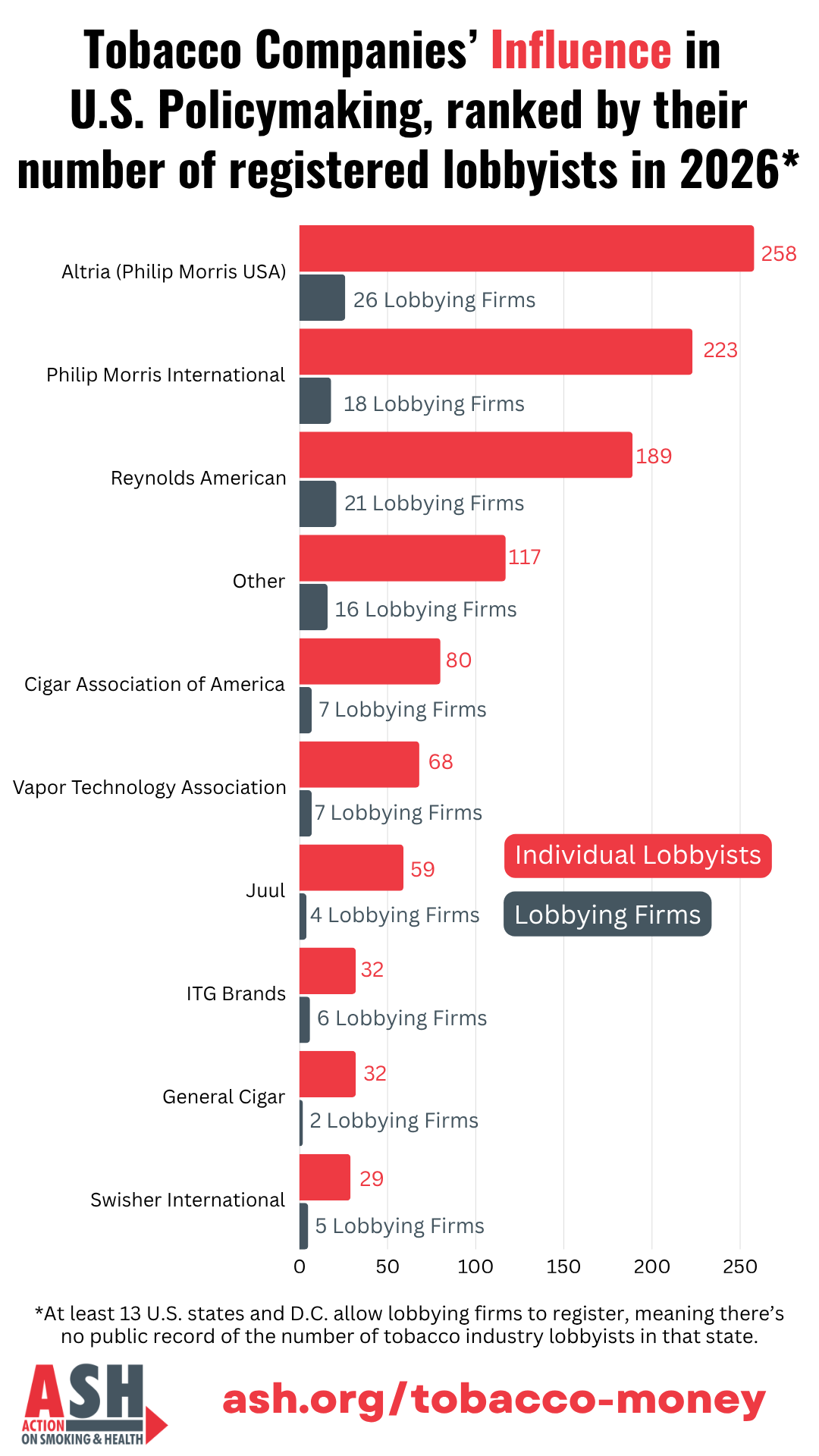
Altria and Reynolds American alone account for 494 of the 1,199 registrations, more than 40 percent. Altria Group and Reynolds American’s subsidiary R.J. Reynolds Tobacco Company were found liable in 2006 for civil violations of the Racketeer Influenced and Corrupt Organizations Act (RICO), and other registrants represent companies owned by or affiliated with them. Others, like JUUL, have faced significant legal and regulatory action, including a $462 million multistate settlement in 2023 over allegations involving youth marketing and a 2019 FDA warning for marketing its products with unauthorized reduced-risk claims. Lobbying is not inherently problematic, but the RICO findings raise serious concerns about the influence of companies with documented histories of deceiving the public about the health risks of cigarettes. These concerns are especially acute in a U.S. cigarette industry dominated by federally adjudicated racketeers, whose products can kill when used as intended.
Altria (previously known as Philip Morris) had a total of 284 registrations of lobbyists or lobbying firms, covering all 50 states and the District of Columbia. Philip Morris International (PMI), which acquired a controlling interest in Swedish Match in November 2022, had a total of 241 registrations covering 49 of the 51 jurisdictions. Reynolds American had a total of 210 registrations, also covering 49 of the 51 jurisdictions (see below for additional trends).
The cross-sector analysis identifies representatives who also serve other clients. These overlaps can help advocates investigate potential conflicts of interest.
Notably, in at least 13 states— Alabama, Alaska, Arizona, Arkansas, California, Colorado, Indiana, Massachusetts, Michigan, Nebraska, New York, Pennsylvania, and Rhode Island—and in the District of Columbia, lobbying firms are allowed to register in place of individual lobbyists. Because lobbying firms often employ multiple lobbyists, this lack of individual-level disclosure undermines transparency and weakens public oversight, making it harder to see who is actually influencing policy in each state.
The ASH Tracker focuses on publicly available state-level registrations, with links provided to each official state webpage. A spreadsheet of the registration data can be viewed here.
Following the Money: What Tobacco Pays to Lobby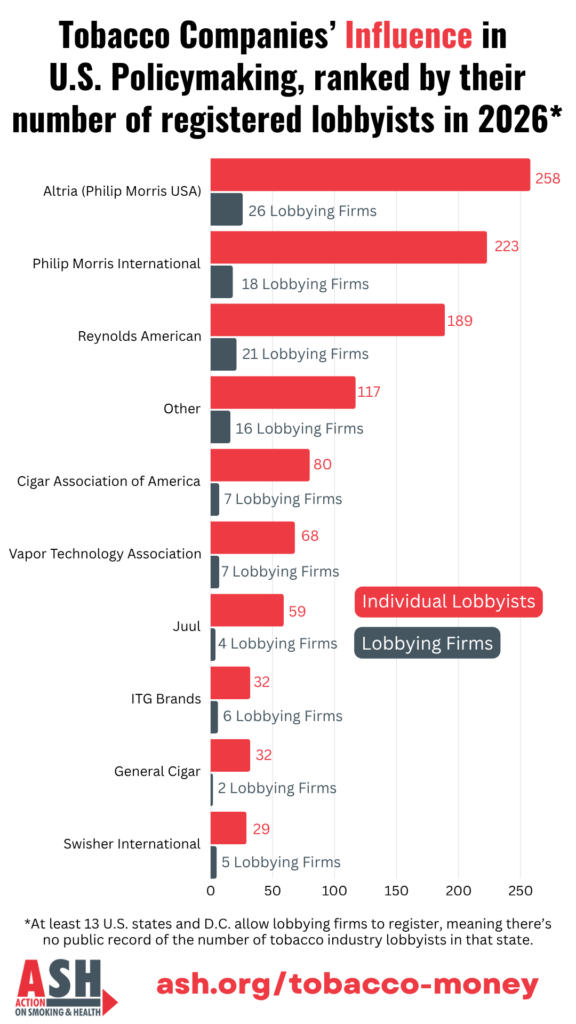
This year, the Tracker goes further than counting registrations. For the first time, it also documents how much the industry spends on lobbying, which firms it hires to represent its interests, and which specific bills tobacco companies are seeking to influence, in the states that publicly disclose that information.
New in 2026, the Tracker includes disclosed tobacco lobbying dollars from 31 of the 51 jurisdictions, using downloaded and hand-entered records. The following are selected recorded totals for available reporting periods within 2021–2026. Reporting bases and periods vary, and 2026 figures are partial where included:
- Texas: $12.19 million midpoint estimate, 2021–2025 (a reported range of $7.6M–$16.8M)
- New York: $11.0 million, 2021–2025
- Florida: $10.74 million estimated total combining point figures and range midpoints (a reported range of $9.0M–$12.5M)
- California: $9.92 million
- Pennsylvania: $4.61 million
- Minnesota: $4.36 million (principal spending, through 2025)
- Tennessee: $4.17 million midpoint estimate (a reported range of $3.0M–$5.34M)
- Connecticut: $3.74 million
- Maryland: $3.61 million
- North Carolina: $3.48 million (through 2024)
- Colorado: $3.23 million
- Oregon: $3.15 million
- …and 19 additional jurisdictions, with recorded totals of approximately $235,000 to $3.1 million over their available reporting periods.
The Tracker includes disclosed lobbying dollars from 31 jurisdictions, but these figures measure different things. Some records show compensation paid to individual lobbyists or lobbying firms. Others, such as Minnesota’s principal expenditure reports, show broader spending by the company that hires them, which can include in-house lobbying costs. Florida’s figures combine point amounts and reported ranges, while Texas and Tennessee report compensation in ranges. Reporting periods also differ. These figures should therefore be interpreted within each jurisdiction; they should not be added together or presented as a comparable national spending total.
Who Gets Paid
Where states name the payee, the Tracker ties compensation to the specific lobbying firm carrying tobacco’s brief. This is now the case in most covered states, including California, Florida, New York, Texas, Oregon, and Massachusetts. Examples of recorded payments to named firms over available reporting periods within 2021–2026 are listed below. Periods differ, and Florida amounts include estimates derived from reported ranges; these examples are not a directly comparable ranking:
- Lang, Hansen, Giroux & Kidane (California): $1.9 million, for Altria
- Bolton-St. Johns (New York): $1.89 million, 2021–2025, for Reynolds American and other tobacco interests
- Sloat Higgins Jensen & Associates (California): $1.59 million, for Reynolds American
- Capitol Strategic Advisors (California): $1.44 million, for the Cigar Association of America and JUUL
- Ballard Partners (Florida): $1.38 million, for Reynolds American
- Rubin, Turnbull & Associates (Florida): $1.24 million, for JUUL and Dosal Tobacco
- The Southern Group (Florida): $1.13 million, for Altria
- Tenax Strategies (Massachusetts): $957,000, for Altria
The Minnesota and Washington totals used here are not attributed to individual firms in this dataset.
What They Are Lobbying On in 2026
Where states disclose the subject of tobacco lobbying, the Tracker now records the specific 2026 bills and each company’s position, in the filer’s own words. Recent examples include:
- Colorado, SB26-086, Reduce Premium Cigar Excise Tax Rate. The Cigar Association of America is registered in support.
- Colorado, HB26-1289, Modification of Certain Tax Expenditures. Altria is registered as amending, ITG Brands as monitoring, and other tobacco interests in opposition.
- Delaware, HB 215, which redefines “tobacco product” to include nicotine pouches. Altria, Philip Morris International, and Reynolds American are all working the bill.
- Delaware, SB 77, which prohibits the sale of electronic smoking devices not listed on the state’s approved directory. Altria and Reynolds American are engaged.
The analysis includes lobbying subjects from eight jurisdictions: Colorado, Delaware, the District of Columbia, Alaska, Connecticut, Hawaii, Idaho, and Maine. The collected Colorado and Hawaii records also include explicit bill positions. These records are a snapshot of the bills and lobbying interests collected for 2026, not a complete inventory of every state’s disclosures.
Tobacco Company Trends Continued
Philip Morris International saw the most significant increase, from 206 registrations in 2025 to 241 in 2026, a 17 percent increase. Over the longer run, PMI has grown from just 48 registrations in 2021, a 402 percent increase across the period, and has now surpassed Reynolds American to rank second by state registrations among the companies tracked.
JUUL registrations increased from 56 in 2025 to 63 in 2026, a 13 percent rise, continuing a recovery from a 2024 low of 26, though still well below the company’s 138 registrations in 2021.
General Cigar saw a slight increase, from 33 registrations in 2025 to 34 in 2026.
ITG Brands appears as a stand-alone company for the first time in 2026, with 38 registrations. In prior years its activity was counted within the “Other” category of the Tracker, so its trend is not directly comparable.
Swisher International decreased from 42 registrations in 2025 to 34 in 2026, a 19 percent decrease.
The Vapor Technology Association decreased from 87 registrations in 2025 to 75 in 2026, a 14 percent decrease, though it remains roughly five times its 2021 level of 15 registrations.
Altria decreased from 312 registrations in 2025 to 284 in 2026, a 9 percent decrease, but remains the single largest presence and the only company registered in every state and the District of Columbia.
Cigar Association of America decreased from 94 registrations in 2025 to 87 in 2026, and Reynolds American decreased from 217 to 210, a 3 percent decrease.
“Other” companies (such as state-specific companies and trade associations) fell from 228 registrations in 2025 to 133 in 2026. Part of that decline reflects ITG Brands being separated into its own category rather than a true drop in activity.
The defining trend of 2026 is the continued rise of Philip Morris International. After acquiring a controlling interest in Swedish Match in November 2022, PMI has expanded its state footprint faster than any other major tobacco company, moving aggressively into oral nicotine and pouch products even as it maintains its combustible business. Its climb to second place by tracked state registrations, alongside its engagement on bills that would redefine “tobacco product” to include nicotine pouches, points to the industry moving toward next-generation products and the tax and regulatory questions they raise.
VTA registrations fell from 87 in 2025 to 75 in 2026, while JUUL registrations rose from 56 to 63. VTA remains above its 2021 level of 15 registrations, while JUUL remains below its 2021 level of 138. These patterns describe recorded registrations; they do not, by themselves, establish changes in market size or the causes of lobbying activity.
Taken together, the three diversified majors, Altria, PMI, and Reynolds American, now account for roughly 61 percent of all tracked registrations, a field increasingly consolidated around the largest players.
State-Level Lobbying Registration Trends
Please note: some lobbyists and lobbying firms represent multiple clients and may be registered more than once within the same state.
Of the 51 jurisdictions tracked, 15 had more registrations in the 2026 data than in 2025, 30 had fewer, and 6 (Alabama, Arizona, Hawaii, Mississippi, Oklahoma, and West Virginia) showed no change.
The U.S. states with the most registrations in 2026 were:
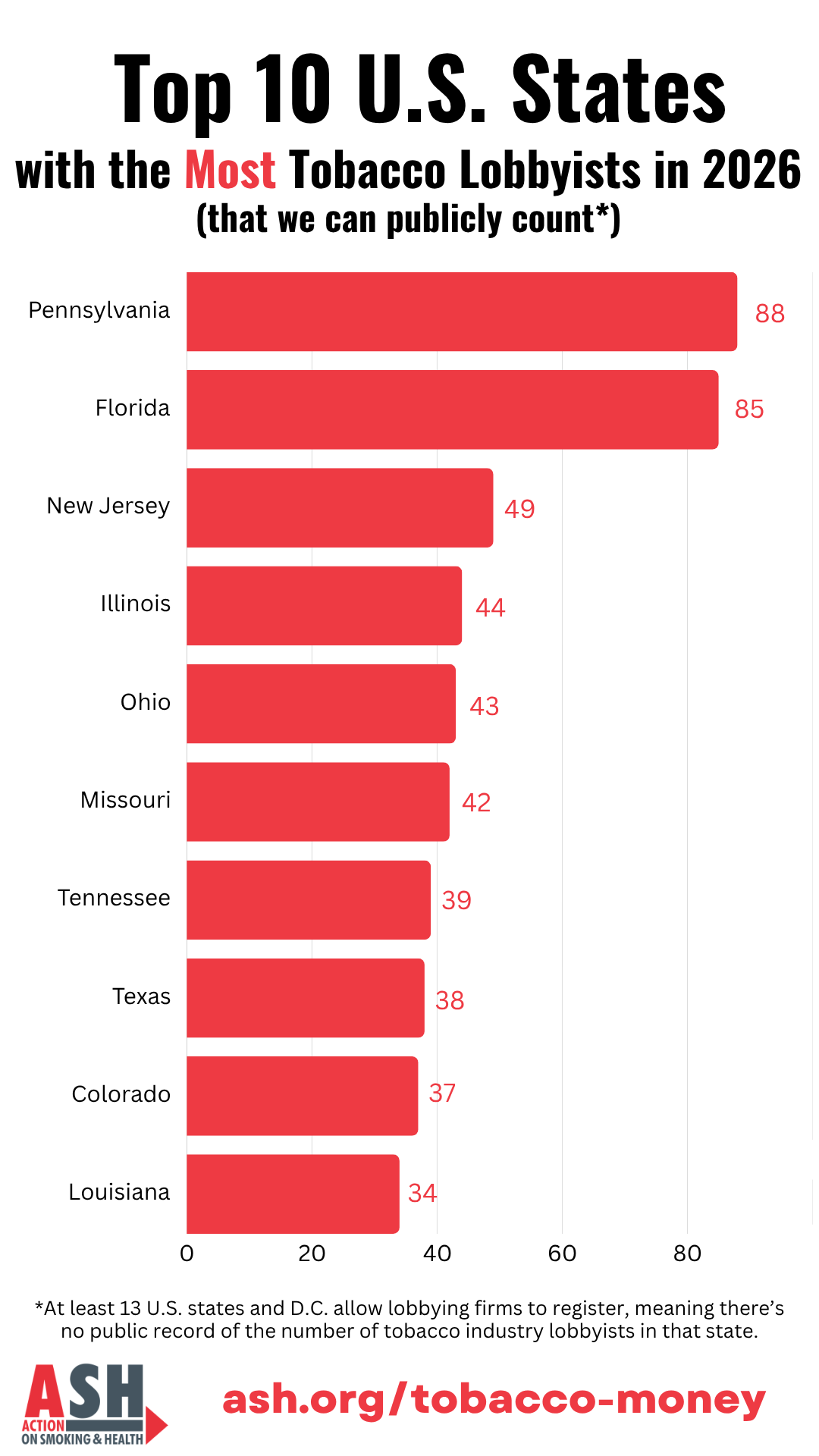 Pennsylvania – 88 total registrations representing:
- 74 individual-lobbyist registrations
- 14 firm registrations
Florida – 85 total registrations representing:
- 85 individual-lobbyist registrations
New Jersey – 49 total registrations representing:
- 49 individual-lobbyist registrations
Illinois – 44 total registrations representing:
- 44 individual-lobbyist registrations
Ohio – 43 total registrations representing:
- 43 individual-lobbyist registrations
Missouri – 42 total registrations representing:
- 42 individual-lobbyist registrations
Tennessee – 39 total registrations representing:
- 39 individual-lobbyist registrations
Texas – 38 total registrations representing:
- 38 individual-lobbyist registrations
Colorado – 37 total registrations representing:
- 35 individual-lobbyist registrations
- 2 firm registrations
Louisiana – 34 total registrations representing:
- 34 individual-lobbyist registrations
How Advocates Can Use the ASH Lobbyist Tracker
 This compiled data shines a light on the scope of tobacco lobbyists and tobacco lobbying firms in each U.S. state, ensuring elected officials, advocates, and media know who they are and whose “advice” not to trust on public health.
There is an irreconcilable conflict between the interests of tobacco companies and public health.
Giving tobacco companies a partnership role in shaping tobacco-control policy conflicts with the safeguards established by Article 5.3 of the World Health Organization Framework Convention on Tobacco Control and its implementation guidelines. These guidelines call for interactions with the tobacco industry to be limited to those strictly necessary for effective regulation and conducted transparently. The United States has signed but not ratified the Convention.
Tobacco companies must be actively excluded from policymaking, and to do that, you must first know who they are. This tracker data shows who cannot be trusted to put forth good public health policy.
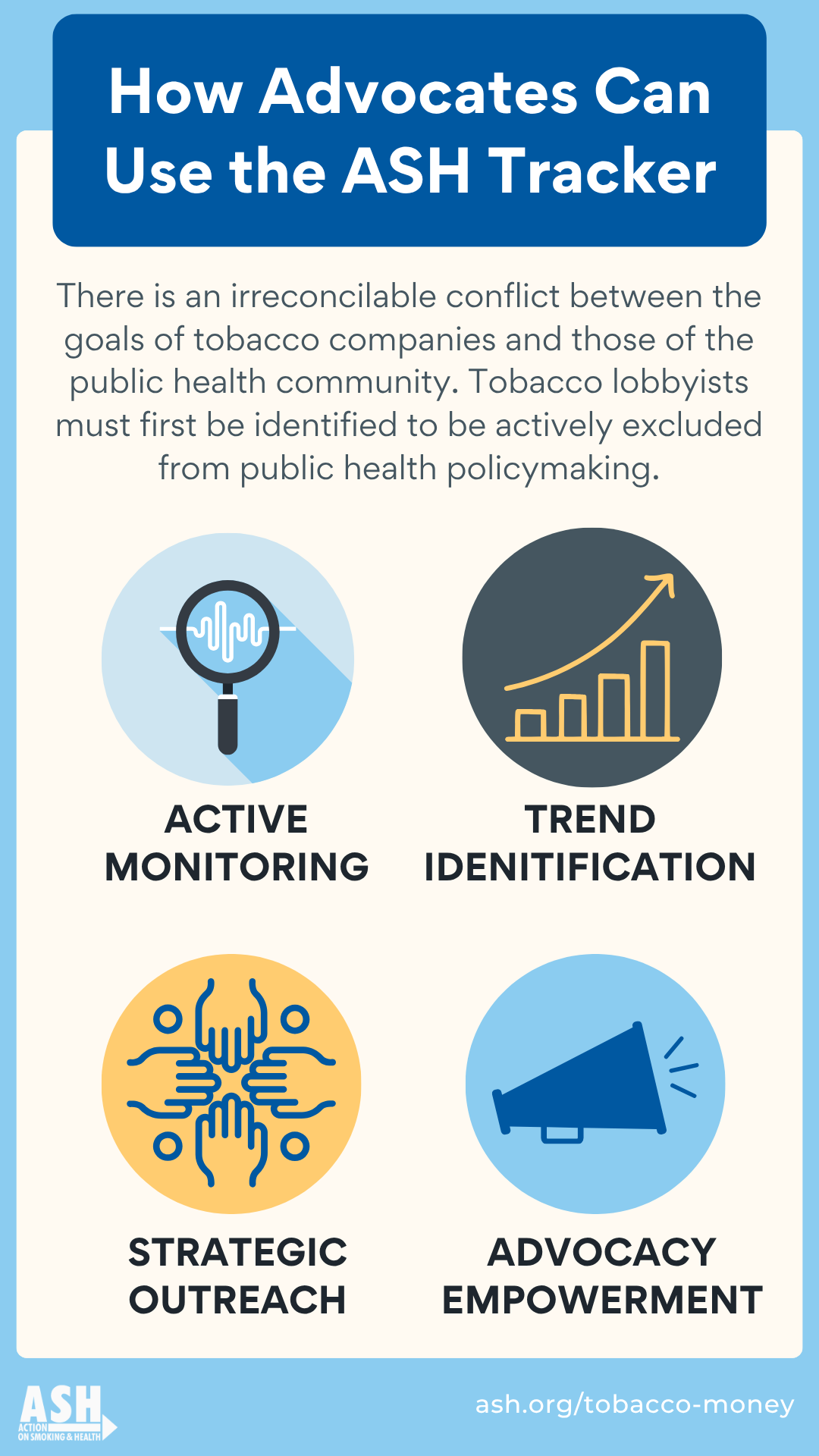
Advocates can use the ASH U.S. Tobacco Industry Lobbyist and Lobbying Firm Registration Tracker to:
- Actively monitor the lobbying efforts of tobacco industry stakeholders in your state to grasp and counteract their influence on policymaking.
- Identify trends in tobacco industry lobbying activities, including which companies, such as PMI and the vaping interests, are expanding their reach, to stay informed and proactive in advocacy efforts.
- Follow the money and the firms behind it, using disclosed compensation and named lobbying firms where states publish them, for targeted outreach to policymakers and community leaders.
- Track the specific bills tobacco is working, and the positions it takes, to anticipate industry moves and respond before legislation advances.
- Craft evidence-based policy recommendations grounded in who is registered, who is paid, and which bills the industry is trying to move.
Learn more about other tactics tobacco companies use to infiltrate public health policymaking in ASH’s U.S. Tobacco Industry Interference Index and the Global Tobacco Industry Interference Index.
Background
This project stems from a similar online tracking project in Oklahoma used by advocates and policymakers to help raise awareness of tobacco industry interference in their state. Inspired by that successful grassroots initiative, ASH and Doug Matheny of the Health Promotion Research Center at the University of Oklahoma Stephenson Cancer Center researched the issue on a national scale to provide this valuable tool to all advocates and policymakers across the United States.
Contact Us with Additions
Not all tobacco lobbyists are employed by a known major tobacco company. If you know of tobacco lobbyists in your state or region that we missed, please contact us at info@ash.org with that information so we can update our Tracker Data accordingly. Thank you!