Media Contact:
Megan Manning
ManningM@ash.org
(202) 659 – 4310
Tobacco Industry Interference Reaches New Heights in U.S.
New Report from ASH Details Violations of Global Best Practices and Recommendations
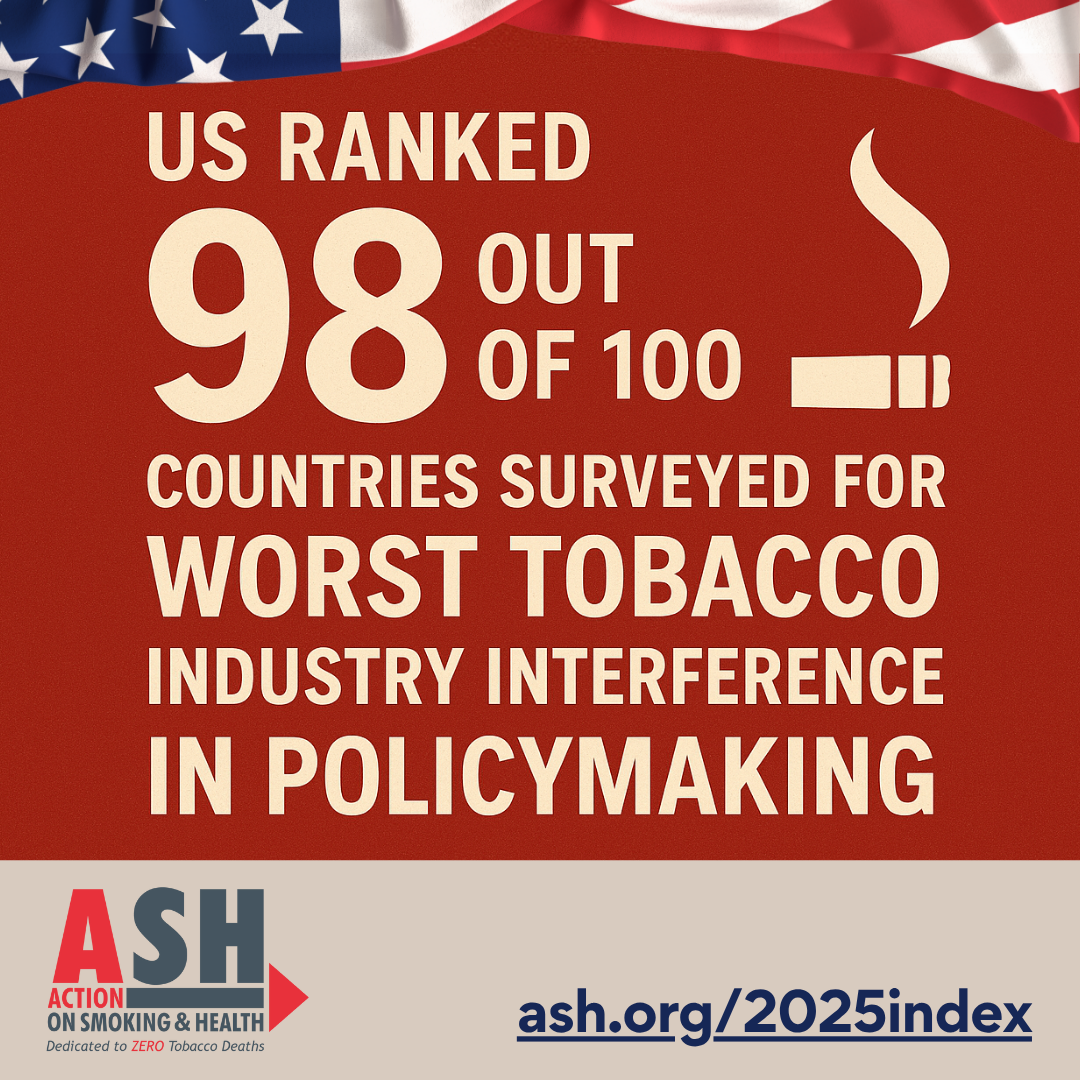
WASHINGTON, DC – OCTOBER 30, 2025 – Today, Action on Smoking and Health (ASH) released the 2025 U.S. Tobacco Industry Interference Index, a biennial report detailing the extent to which decisionmakers in the U.S. are influenced by tobacco industry manipulations. The U.S. ranked 98 out of 100 countries surveyed, its worst rank since the report was first published in 2019.
 The Index is based on indicators from the World Health Organization Framework Convention on Tobacco Control (FCTC). The FCTC is one of the most broadly accepted United Nations treaties, with 183 Parties representing over 90% of the world’s population. The U.S. has signed but not ratified the FCTC, although past administrations have claimed to be in full compliance with the life-saving measures of this treaty.
FCTC Article 5.3 calls on policymakers to actively exclude tobacco companies from the regulation of their own products, as the industry’s goals are inherently in conflict with those of public health. Unfortunately, these recommended protection measures are not in place across the majority of the U.S.
This 5th edition of the US Index shows a worsening trend of tobacco industry interference to slow or weaken public health regulations, resulting in the worst global score the US has received yet.
Read the 2025 U.S. Tobacco Industry Interference Index here>
“The tobacco industry’s playbook hasn’t changed — profit first, health last. The United States’ worsening score reflects that reality,” said Nichelle Gray-Lkhagvadorj, Lead Author of the Index and Manager of Engagement and Special Programs at Action on Smoking and Health. “Protecting public health means keeping the tobacco industry out of policy decisions, full stop.”
“The tobacco industry wrote the playbook — starting in the 1950s — on how to bend governments to its will. This Index is yet another SOS call to urgently protect the politics and policies that shape public health from the profit motive, and to not let the world’s deadliest industries dictate the destiny of our collective wellbeing — even in countries like the U.S. that have not ratified the WHO FCTC,” said Daniel Dorado, Tobacco Campaign Director at Corporate Accountability.
Tobacco companies will always prioritize their profits over public health, and the brazen interference examples outlined in the 2025 US Index reflect that.
 For example, Indicator 4 reviews Forms of Unnecessary Interaction: Philip Morris International (PMI) has a formal partnership with the US Department of Homeland Security (DHS) to combat illicit trade and train law enforcement officers on tobacco enforcement. As former Director-General of the World Health Organization Margaret Chan has said, “Giving any tobacco company a place at the negotiation table is akin to appointing a committee of foxes to take care of your chickens.”
Indicator 3 covers Benefits to the Tobacco Industry: The most notable recent benefit for the tobacco industry was the dismantling of the CDC Office on Smoking and Health in April 2025, ending support for quit lines, the widely successful “Tips from Former Smokers” campaign, and youth prevention initiatives. This move will have deadly consequences, and the 2025 US Index recommends reversing this move immediately. In addition, the Biden Administration blocked the implementation of a proposed rule to ban menthol cigarettes, which was fully withdrawn from consideration by the Trump Administration.
“We can’t ‘Make America Healthy Again’ without restoring the funding and people at the Office on Smoking and Health, which educates the American people about the harms of smoking while helping our states and healthcare systems provide proven assistance to people interested in quitting,” said Dr. Tim McAfee, former Director of CDC’s Office on Smoking and Health.
To better mitigate tobacco industry interference and strengthen tobacco control policies in the U.S., the 2025 US Index report recommends the following comprehensive measures:
1.) Raise awareness of the WHO FCTC and its provisions regarding tobacco industry interference;
2.) Strengthen and standardize revolving door prohibitions;
3.) Close loopholes in executive branch ethics guidelines;
4.) Prevent conflicts of interest in FDA approval processes;
5.) Reinstate and strengthen public health offices to guard against industry interference;
6.) Adopt an official code of conduct for public officials;
7.) Educate lawmakers on industry interference; and
8.) Mandate philanthropic donation disclosure.
The US Index data feeds into the Global Tobacco Industry Interference Index that launches on November 11, 2025. All indicators were established by the Southeast Asia Tobacco Control Alliance (SEATCA) and the Global Center for Good Governance (GGTC) to align with WHO FCTC Article 5.3. The Global Tobacco Industry Interference Index is jointly published and disseminated in partnership with Stopping Tobacco Organizations and Products (STOP).
In the U.S., like most nations, the tobacco industry thrives in secrecy, shielding its policy-influencing strategies from public scrutiny. The 2025 US Index serves to shine a light on their deadly actions. By implementing the 2025 US Index recommendations, the government can promote transparency, address conflicts of interest, and protect public health through robust tobacco control policies.
ACTION ON SMOKING AND HEALTH
Founded in 1967, Action on Smoking and Health (ASH) is America’s oldest anti-tobacco organization, dedicated to a world with ZERO tobacco deaths. Because tobacco is the leading cause of preventable death worldwide, ASH supports bold solutions proportionate to the magnitude of the problem. ash.org
Attend the Virtual 2025 U.S. Index Launch Today, Co-Hosted by Corporate Accountability
Date: Thursday, October 30, 2025
Time: 12:00-1:00pm ET
Registration: Available Here
Speakers and Description:
• Nichelle Lkhagvadorj, Manager of Engagement and Special Programs at Action on Smoking and Health (ASH), will provide an overview of the 2025 U.S. Index findings and highlight how the tobacco industry interferes with policymaking across the U.S. She will also cover how advocates and institutions can respond to tobacco industry interference.
• Allen Gallagher, Research Fellow at the Tobacco Control Research Group (TCRG) at the University of Bath, will share insights into how the tobacco industry’s strategies in the U.S. align with or diverge from global playbooks.
• Ashka Naik, Chief Research and Policy Officer at Corporate Accountability, will discuss moving from documentation to accountability, as well as strategies for strengthening enforcement and government protections against interference.